
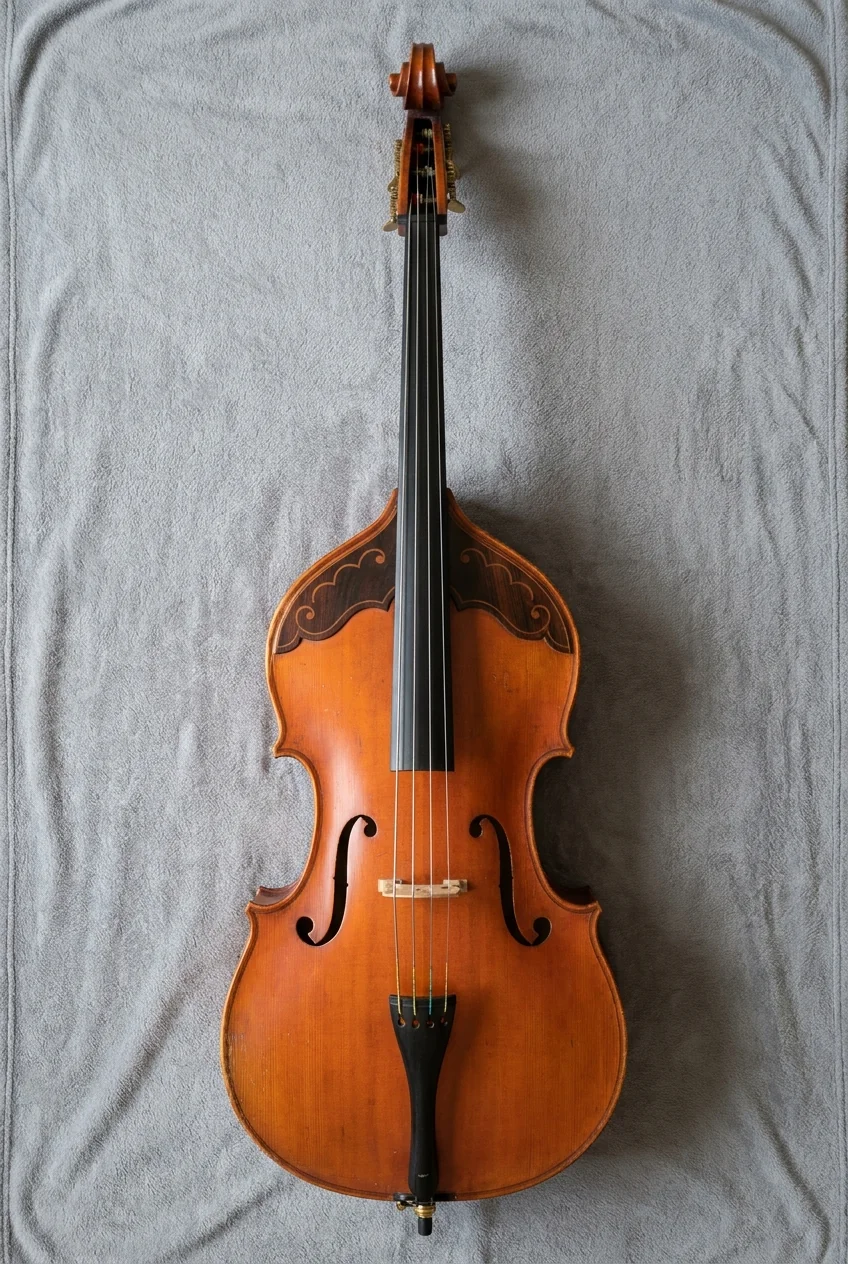
The berda is the largest tamburitza in the family — the upright bass of the tamburitza ensemble. Its role is foundational: it sets the harmonic and rhythmic base of the whole orchestra. Without a berda the ensemble loses its fundament.
Building a berda demands special space and approach. The body is close in dimensions to a classical double bass. The soundboard is from carefully selected spruce; the back and sides are walnut or maple — the wood must be dense enough to bear the mechanical tension of the low strings.
Our berdas carry four strings in the standard double-bass tuning (E-A-D-G). The pick is thicker and harder than on the smaller tamburitzas. Playing ergonomics adjust to the height of the performer — the neck can be adapted.
A berda from our workshop is built with special attention to low projection. The bridge is larger and more massive; the joinery of the body is optimised for bass resonance. Every berda goes through a long acoustic voicing.
The berda was added to the tamburitza orchestra at the end of the 19th century to achieve the same effect a double bass has in a classical orchestra — a foundational bass that sets the harmonic frame of the entire ensemble. In Slavonia and Vojvodina the berda became an indispensable part of the tamburitza tradition, and today it is present in modern ensembles across the diaspora. In size it is almost identical to a classical double bass, but the playing style and the characteristic tamburitza approach make it a special instrument.
Building a berda in our workshop takes sixteen to twenty-four weeks — the longest build in our tamburitza family. The starting price for a standard berda is EUR 1400. Because of the size, customers can specify ergonomic adjustments (neck height, back angle, instrument weight), the selection of dense wood, the number of strings and specific details. Picking up the berda in person in Varaždin is recommended for logistical reasons, but we also arrange delivery in Croatia and neighbouring countries.
A berda is not an instrument that is bought casually — it is ordered for decades of use and passed between generations. Our workshop builds berdas with that in mind: construction that withstands the mechanical tension of low strings, wood that will mature over the years, restoration reversibility of all joints. Tamburitza service for berdas includes acoustic voicing, peg repair, new bridge cutting and complete restoration of antique instruments.
Wood for a berda must be the densest and most stable in our whole tamburitza family. Spruce for the soundboard rests for as long as seven years before use. Walnut or maple for the back is sourced from suppliers where trees grow slowly and with uniform fibre. The neck is often built from a laminated walnut-maple composite — that approach minimises bending under the tension of four very thick bass strings. A hand-built berda from Varaždin is recognisable for its deep resonant bass that does not fade with the years but, on the contrary, matures with the instrument.