
How a tamburitza is made
From log to first tone — six steps, several weeks of work.
Selecting the wood
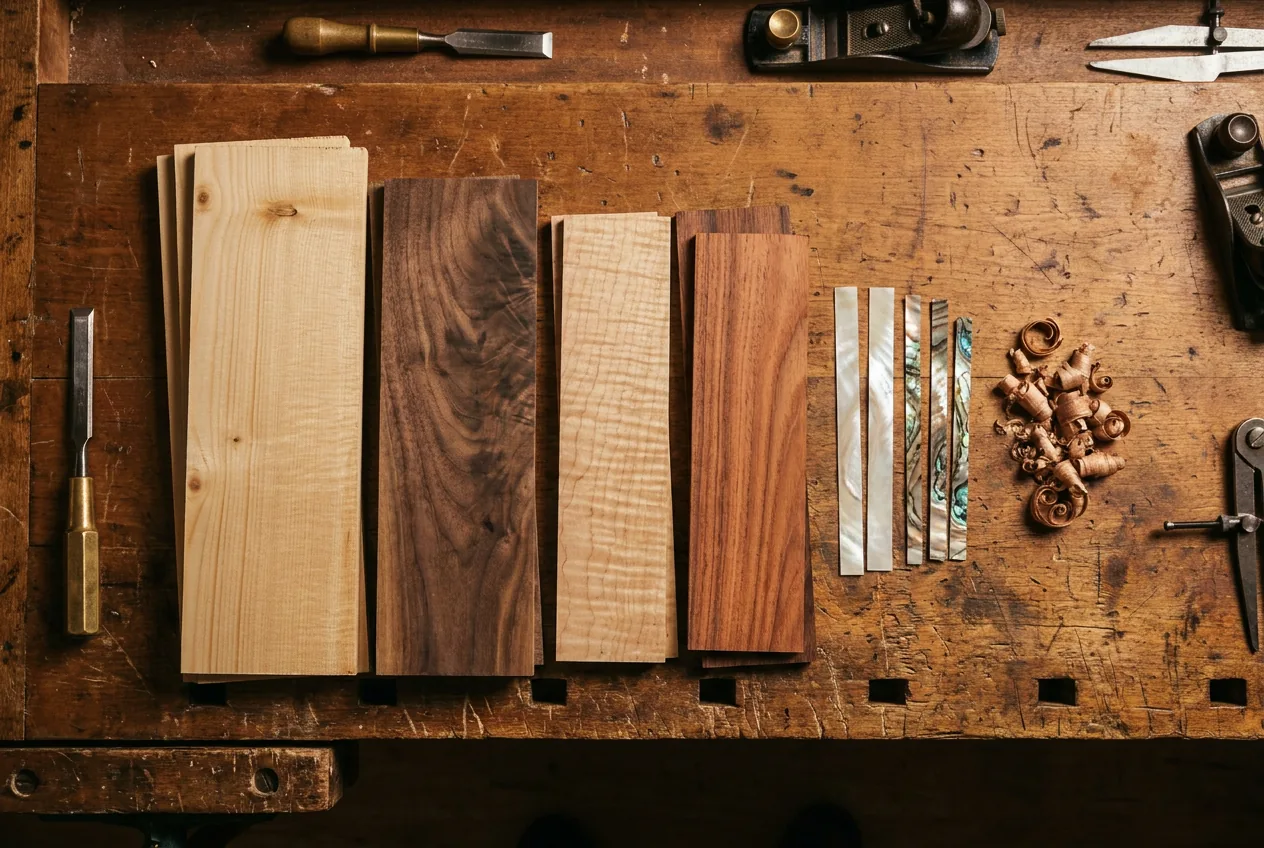
It all begins with the wood. For the soundboard we use spruce from high altitudes — wood that has grown slowly, dense, with even growth rings. For the back, sides and neck we use walnut or maple. Every piece rests for several years under controlled humidity before we put it on the bench. The grain orientation is checked with light and tap-tone — the wood must tell us it is ready.
Building the body
The soundboard is hand-graduated — its thickness varies by the millimetre to match the resonance properties. The sides are bent over a heated mould. The back is jointed, sanded, fitted. Internal bracing is cut and glued one strip at a time. The whole body is assembled with hide glue — no modern synthetics, because it must be possible to take apart for future restoration.
Neck and fingerboard
The neck is shaped from a single piece of walnut or maple, sculpted by hand to the ergonomics of the player. The fingerboard is ebony — dense, durable, acoustically neutral. Frets are seated by hand, one at a time, to a precise tempered scale. The joint between neck and body is critical to the balance of the instrument — done with a classical dovetail.
Finishing
Traditional shellac is applied in about ten thin coats — each layer is polished by hand before the next is laid down. Shellac does not choke the sound the way modern polyurethane lacquers do; the instrument breathes. The whole process takes a week. The final patina lends warmth and depth that only deepens with the years.
Stringing and voicing
The bridge is cut and fitted individually for each instrument — height, angle and weight all affect tone. Strings are mounted in the traditional pairs or fours. The first notes are a rough check. Real voicing comes weeks later, once the wood and finish have settled, and the instrument returns to the bench for fine adjustment.
The acoustics of the tamburitza
The sound of a tamburitza is the product of plate geometry, the mass and stiffness of the neck, the choice of strings, and countless small decisions a maker takes during the build. The bisernica must sing bright and penetrating; the brač warm and focused; the berda deep and grand. Every size has its own acoustic laws that cannot be cheated.